How Good Are Pickleball Injury Studies? Reading a Scoping Review
Posted October 22, 2026 Revised October 22, 2026 4-minute read
By the Bien Chaussé editorial team.
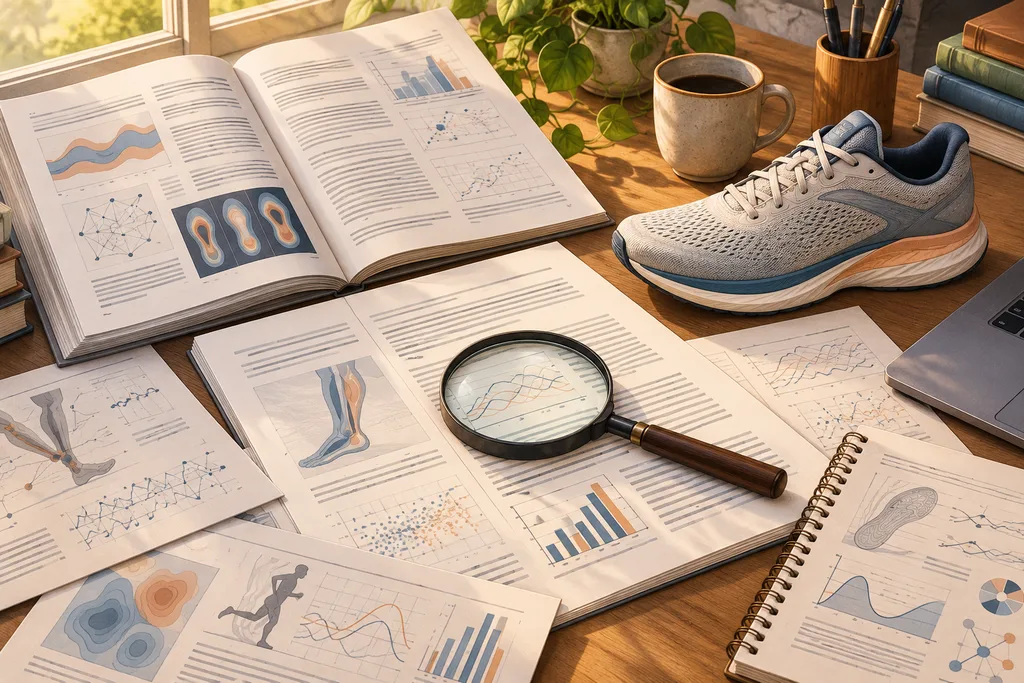
This talk, "How Reliable Are Pickleball Injury Studies? Reading a Scoping Review," moves through stages announced in advance. You'll learn to tell a scoping review from a clinical study and to gauge how solid the injury figures cited really are. My outline covers what stands out, what causes it, and the benchmarks that help you decide.
What Stands Out
Look at this figure: in the United States, emergency departments recorded about 66,350 pickleball injuries (a national estimate based on 1,110 NEISS cases) between 2013 and 2022.
On to the reference values: the body parts most affected in injuries seen in emergency departments are the wrist (12.7%), the lower trunk (12.1%), and the lower leg (11.7%).
The measured benchmark: in the study presented at the AOFAS in 2024, 58% of patients are men, and calf problems (gastrocnemius strain, Achilles tendinopathy) account for nearly 70% of injuries.
Look at this figure: in US emergency departments, fractures account for 32.7% of diagnoses (69.1% of them in women) and sprains or strains for 30.8%. Women have more fractures, men more sprains.
What Causes It
Start with this foundation: Mass General Brigham distinguishes overuse injuries (elbow and Achilles tendinopathy) from acute traumatic injuries caused by a fall or a sudden change of direction (meniscus and anterior cruciate ligament tears). Use this point as a reading guide.
Here's the guiding idea: the injury mechanisms described for the foot and ankle are running or lunging forward, a planted foot during a pivot, and ankle inversion movements. Pause for a moment on that wording.
Here's the guiding idea: an ankle sprain happens during a sudden change of direction, when the foot rolls outward and the ligaments stretch or tear. An ankle brace is suggested for players with a weak or previously sprained ankle. Connect this point to the parts ahead.
Benchmarks for Deciding
Check your own situation against these criteria.
- The podiatrist recommends matching the sole to the surface — a gym's wood or laminate floor calls for a firmer sole, while outdoor play benefits from a sole that absorbs shock better.
- According to surgeon Carl Cirino (HSS), you don't need pickleball-specific shoes: a tennis or squash shoe with a flat, sturdy sole works to keep you from tripping and falling.
What to Watch Closely in Practice
Beware of the pitfalls below.
- According to podiatrist Sarah Cantin-Langlois, running shoes suit linear motion but don't offer the support and stability pickleball's lateral movements demand.
- Running shoes, with a rounded sole that encourages forward momentum, are a poor fit for pickleball. HSS recommends a flat, stable base.
What Is a Scoping Review?
A move to adopt: Mass General Brigham recommends cross-training (cycling, yoga) for underused muscles, plus strengthening (core work, squats, lunges), and seeing a doctor if the pain persists after a few days.
Look at this figure: in this study (198 injuries, average age 58), Achilles tendon rupture is the most common diagnosis, with 78 cases, and about 80% of injuries are traumatic.
Let's see how this plays out: Mass General Brigham notes that wrist fractures mostly affect older women, that adults mostly get hurt in falls and teenagers from paddle impacts, and it recommends protective eyewear to prevent eye injuries.
To Close
We've come to the end: what stands out, what causes it, the benchmarks for deciding, and what to watch closely in practice. Run through the list of takeaways once more before you close this page.
See also
- Pickleball Shoes and Injuries: What the Studies Say — Shoes, sprains and prevention. This page covers the guiding principles, the articles to explore, how to get started and what sets the options apart.
- Why Ankle and Foot Injuries Are Rising in Pickleball — You'll see what the published data show on foot and ankle injuries in pickleball, and how to read those numbers with some perspective.
- Ankle Sprains in Pickleball: Prevention and Response — You'll learn which moves and gear lower your ankle sprain risk, and when to see a doctor. This page covers the core idea up close, then the how-to.
- Fatigue, Overuse and Foot Comfort: Adapting Your Play — You'll learn to spot an overuse injury and adjust how often you play, how much you rest and your shoes. This guide covers where to start.
Sources
- Increasing Incidence of Pickleball Injuries Presenting to US Emergency Departments: A 10-year Epidemiologic Analysis of Mechanisms and Trends — Analysis of 2013-2022 NEISS data on pickleball injuries seen in US emergency departments. Reference reread on 2026-10-18.
- Foot and ankle injuries in pickleball increased 6 .5-fold from 2019 to 2023 (Healio) —
- Pickleball injuries (version française) — Common injuries (ankle, Achilles tendon, elbow, wrist), the importance of a well-fitted shoe suited to the surface, and prevention tips. Reference reread on 2026-10-18.
- Preventing foot and ankle injuries in pickleball — Health information page from a medical group on foot and ankle injuries in pickleball. Reference reread on 2026-10-18.
- The Globe and Mail : conseils d'experts pour choisir ses chaussures de pickleball —
- Hospital for Special Surgery : conseils de prévention des blessures au pickleball —
The information on this site is general and doesn't replace the advice of a doctor, physical therapist, or podiatrist, especially if you have pain, an old injury, or an unusual foot.
The site doesn't sell shoes or publish paid rankings: the models mentioned are for information only.
What We Verified.
This article draws on 6 sources: 3 official or institutional sources, 1 scientific publication, and 2 press articles.
Facts checked against their sources on October 18, 2026.
The method we followed: Notre méthode.