Fatigue, Overuse and Foot Comfort: Adapting Your Play
Posted October 22, 2026 Revised October 22, 2026 3-minute read
By the Bien Chaussé editorial team.
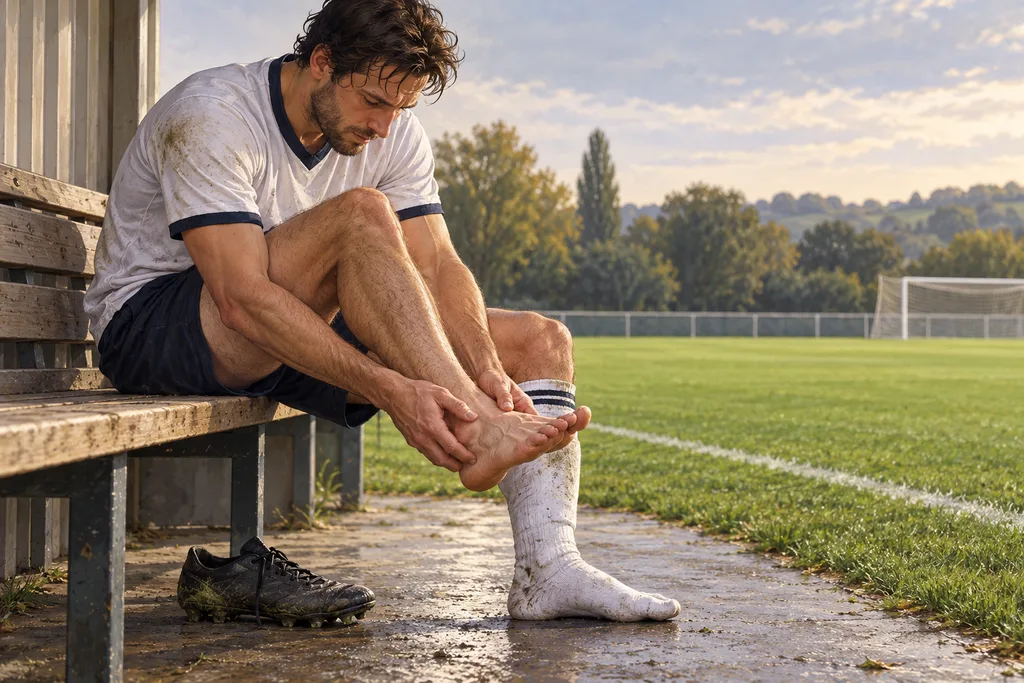
Let me open "Fatigue, Overuse, and Foot Comfort: Adapting How You Play" by telling you how I'll proceed. You'll learn to recognize an overuse injury and adjust your frequency, rest, and shoes. We'll cover two parts in order: where to start, and other no-nonsense benchmarks on the subject.
Where to Start
Follow these steps without skipping any.
- Sound technique, good foot placement, and proper posture put less strain on muscles, tendons, and ligaments, according to Dr. Matzkin, cited by Mass General Brigham.
- In this study, conservative treatment (immobilization, physical therapy, the RICE protocol) is the most common. Dr. Smith recommends a warm-up, stretching, court shoes, and, if the ankle is unstable, taping or a brace.
- Mass General Brigham recommends a dynamic warm-up before you play (butt kicks, runner's lunges, trunk rotations) and saving static stretching for after the match.
- For a sprain, Mass General Brigham recommends the R.I.C.E. protocol (rest, ice, compression, elevation) and advises against prolonged use of anti-inflammatories, which could limit tendon healing.
How Do You Recognize Overuse Pain?
Read this carefully: in this study, 57 patients had surgery, most often to repair the Achilles tendon.
Look at this figure: in this analysis of US emergency departments, 61.1% of injuries involve 65-80-year-olds and 31.3% involve 35-64-year-olds. The average age of injured players is 64.
A tip on method: Mass General Brigham recommends cross-training (cycling, yoga) for underused muscles, plus strengthening (core work, squats, lunges), and seeing a doctor if the pain persists after a few days. Write it down so you can refer back to it.
Can a Worn Shoe Contribute?
A good habit to build: an orthopedic surgeon recommends, in addition to court shoes with lateral support, regular strengthening of the shoulders, core, and legs, flexibility work (yoga, Pilates), and stopping to rest as soon as pain appears rather than pushing through.
Look at this figure: in this study (198 injuries, average age 58), Achilles tendon rupture is the most common diagnosis, with 78 cases, and about 80% of injuries are traumatic.
Read this carefully: the estimated number of pickleball injuries treated in US emergency departments rose from 611 in 2013 to 13,690 in 2022, a more than 22-fold increase.
Should You Play Less Often?
Look at this figure: the body parts most affected in injuries seen in emergency departments are the wrist (12.7%), the lower trunk (12.1%), and the lower leg (11.7%).
Let's see how this plays out: Mass General Brigham notes that wrist fractures mostly affect older women, that adults mostly get hurt in falls and teenagers from paddle impacts, and it recommends protective eyewear to prevent eye injuries.
Read this carefully: in US emergency departments, fractures account for 32.7% of diagnoses (69.1% of them in women) and sprains or strains for 30.8%. Women have more fractures, men more sprains.
Other No-Nonsense Benchmarks on the Subject
On to the reference values: in the United States, emergency departments recorded about 66,350 pickleball injuries (a national estimate based on 1,110 NEISS cases) between 2013 and 2022.
To Close
You've covered where to start and other no-nonsense benchmarks on the subject. Note the points that speak to you, then come back to them when you need them.
See also
- Pickleball Shoes and Injuries: What the Studies Say — Shoes, sprains and prevention. This page covers the guiding principles, the articles to explore, how to get started and what sets the options apart.
- Ankle Sprains in Pickleball: Prevention and Response — You'll learn which moves and gear lower your ankle sprain risk, and when to see a doctor. This page covers the core idea up close, then the how-to.
- Why Ankle and Foot Injuries Are Rising in Pickleball — You'll see what the published data show on foot and ankle injuries in pickleball, and how to read those numbers with some perspective.
- How Good Are Pickleball Injury Studies? Reading a Scoping Review — You'll learn to tell a scoping review from a clinical study and to gauge how solid the figures cited on pickleball injuries are.
Sources
- Pickleball injuries (version française) — Common injuries (ankle, Achilles tendon, elbow, wrist), the importance of a well-fitted shoe suited to the surface, and prevention tips. Source access checked on 2026-10-18.
- Foot and ankle injuries in pickleball increased 6 .5-fold from 2019 to 2023 (Healio) —
- Increasing Incidence of Pickleball Injuries Presenting to US Emergency Departments: A 10-year Epidemiologic Analysis of Mechanisms and Trends — Analysis of 2013-2022 NEISS data on pickleball injuries seen in US emergency departments. Source access checked on 2026-10-18.
- Common Pickleball Injuries and Tips to Prevent Them — Advice from an orthopedic surgeon (Dr. Greg Erickson) on common injuries and how to prevent them. Source access checked on 2026-10-18.
The information on this site is general and doesn't replace the advice of a doctor, physical therapist, or podiatrist, especially if you have pain, an old injury, or an unusual foot.
The site doesn't sell shoes or publish paid rankings: the models mentioned are for information only.
What We Verified.
This article draws on 4 sources: 2 official or institutional sources, 1 scientific publication, and 1 specialized or general press article.
Facts checked against their sources on October 18, 2026.
The method we followed: Notre méthode.